Showing posts with label John Roberts. Show all posts

Tuesday, June 25, 2013

Supreme Court Strikes Down Part of Voting Rights Act


Don't believe the hype. While white liberals and their messengers in the mainstream media will deem this SCOTUS decision as "RACIST!!!", the truth is that not only did "history not end in 1965", but it's the Left's own ignorance towards widespread voter fraud (all in the name of making sure blacks continue to vote overwhelmingly Democrat) that partly served as the lightning rod for this case being heard by SCOTUS in the first place:
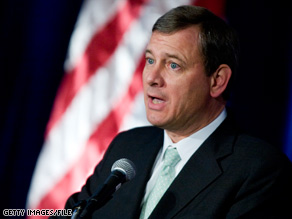
In a landmark 5-4 decision today, the Supreme Court struck down a section of the Voting Rights Act that designated that the Act applied only to certain parts of the United States. Chief Justice John Roberts wrote the majority opinion. 

Section 5 of the VRA dictated that state and local governments in the United States would have to get approval from the federal Department of Justice to change their election laws. Section 4 of the VRA contains the formula that determined which parts of the United States that Section 5 applies to. It was Section 4 of the VRA that the Supreme Court struck down today, which means that Section 5 will go unenforced until Congress can come up with an alternative formula for determining which governments must receive approval for election law changes. 

Notably, Chief Justice Roberts' opinion leaves the possibility that Congress can come up with a legally sound formula that would still limit the Section 5 requirements to only some parts of the United States - but that Section 4 is currently constitutionally unacceptable.

Professor William Jacobson of Legal Insurrection pulled out the key part of Chief Justice Roberts' opinion:
The Voting Rights Act of 1965 employed extraordinary measures to address an extraordinary problem. Section 5 of the Act required States to obtain federal permission before enacting any law related to voting—a drastic departure from basic principles of federalism. And §4 of the Act applied that requirement only to some States—an equally dramatic departure from the principle that all States enjoy equal sovereignty. This was strong medicine, but Congress determined it was needed to address entrenched racial discrimination in voting, “an insidious and pervasive evil which had been perpetuated in certain parts of our country through unremitting and ingenious defiance of the Constitution.” South Carolina v. Katzenbach, 383 U. S. 301, 309 (1966). As we explained in upholding the law, “exceptional conditions can justify legislative measures not otherwise appropriate.” Id., at 334. Reflecting the unprecedented nature of these measures, they were scheduled to expire after five years. See Voting Rights Act of 1965, §4(a), 79 Stat. 438.
Nearly 50 years later, they are still in effect; indeed, they have been made more stringent, and are now scheduled to last until 2031. There is no denying, however, that the conditions that originally justified these measures no longer characterize voting in the covered jurisdictions….
At the same time, voting discrimination still exists; no one doubts that. The question is whether the Act’s extraordinary measures, including its disparate treatment of the States, continue to satisfy constitutional requirements.
RELATED:  Breaking: Supreme Court strikes down part of Voting Rights Act

Monday, July 02, 2012

Politiks As Usual: 7/2/12

Report: Roberts Switched His Vote On The Mandate

Congress OKs Highway Funds-Student Loan Bill 

Minnesota Reverend Loses Church Over Support Of Same-Sex Church

Why Roberts Deserves Conservative Scorn

George Will Argues Obamacare Ruling Was Victory For Conservatives

Racial Politics Thicker Than Justice

Candy Crowley Calls Out President Obama For Executive Privilege Hypocrisy On Fast & Furious

How Liberals Become Cover Girls in the Capitalist System They Oppose

CNN Promotes Stripper’s Claim that Catholic Church 'Dirtier Than What Goes on in Strip Clubs'

Romney-Trashing Reporter Joe Williams Done at Politico

Say Thanks To Stockton 

5 Reasons The Supreme Court’s Obamacare Ruling Helps the GOP

5 Reasons For Katie Holmes And Tom Cruise's Divorce According To Twitter

Saturday, June 30, 2012

Fox News Watch Marvel At Media’s Promotion Of Justice Roberts From ‘Right Wing Goon’ To ‘Hero’


Mediaite.com:
By far the biggest story of this week was the Supreme Court’s ruling upholding the constitutionality of fining individuals for not having health insurance, a move that Justice John Roberts wrote fell under the taxing authority of Congress. On Fox News Watch today, the panel noted that his decision to side with the more liberal justices appeared to change the tone of liberals in the media when referring to him, who now saw him as a “hero” for what he wrote.


Jim Pinkerton joked that the turnabout by the media in warming up to Justice Roberts had been dubbed by “some wiseguy in DC” the “Greenhouse Effect”– namely, Linda Greenhouse, whose writing “moved the courts in her direction.” He also joked that a week ago, Justice Roberts was a “right-wing goon,” to which host Jon Scott interjected to point out how Chris Matthews reacted– going from claiming Justice Roberts could be “compared to a Civil War-era supreme court judge who upheld the Dred Scott Slave Act” to “a hero.”


“Here the bias is so obvious,” Judith Miller replied, noting that at least the “legal media see his reasoning as specious and his about-face as, well, an about-face.” Kirsten Powers, on the other hand, took a look at the way conservative media reacted– namely, “very, very angry.” he agreed it was “historic” and “a big victory for Obama,” but didn’t see Justice Roberts as siding with conservatives, given that “his reasoning was completely different than theirs.” Richard Grenell agreed, explaining that Justice Roberts had now “saddled ‘the President’ with a terrible scalet T… he has to go into the campaign season with the label of a taxer.”


As for Mitt Romney and the election, Miller expressed some surprise that Romney had not “taken advantage of the moment,” though “he did talk about the elements that he would have in his plan.” Pinkerton thought the President was not in the best position given the decision. People “oppose Obamacare as a thing, and if he spends the next five months defending it, that’s a bad thing,” he concluded. 
RELATED: Krauthammer To Hannity: Roberts Was Protecting The Court’s ‘Reputation’ With Health Care Decision

Thursday, June 28, 2012

Liberals Can Thank George W. Bush For Passing Obamacare

Funny how this worked out. Justice John Roberts, a George W. Bush appointee, sides with the liberal faction of SCOTUS and passes the Affordable Care Act (aka "Obamacare"). While the initial reaction is to state what a "huge victory" this is for Obama, considering that the individual mandate passed as a tax rather than under the commerce clause (which is what Democrats wanted) when people start reading and understanding exactly how this thing passed, critics, pundits and pols (including Barry) alike may start to feel different about this decision in a day or two. Then too is the fact that Obamacare, due to its intrusive intricacies on personal choice, was never popular with most Americans in the first place...but now it's the law of the land:
The Supreme Court on Thursday upheld nearly all of President Obama's health care overhaul, in a landmark ruling that will have sweeping consequences for the economy, the election and America's health care system. 
In a 5-4 decision, the court ruled as constitutional the so-called individual mandate requiring most Americans to obtain health insurance starting in 2014. 

The ruling is a victory for the president, ensuring for now that his signature domestic policy achievement remains mostly intact. It also ensures that the law will play a prominent role in the general election campaign, as Republican candidate Mitt Romney vows to repeal the law if elected.

Obama is expected to speak publicly about the ruling later in the day. 

Chief Justice John Roberts, who was appointed during a Republican administration, joined the four left-leaning justices on the bench in crafting the majority decision. 

"The Affordable Health Care Act survives largely unscathed," Justice Ruth Bader Ginsburg, one of those justices, declared at the end of the reading, claiming the "setbacks" going forward will be "temporary blips, not permanent obstructions." 

The ruling relied on a technical explanation of how the individual mandate could be categorized. Roberts, in the opinion, said the mandate could not be upheld under the Constitution's Commerce Clause. However, it could be upheld under the government's power to tax. 

"The Affordable Care Act is constitutional in part and unconstitutional in part  The individual mandate cannot be upheld as an exercise of Congress's power under the Commerce Clause," Roberts wrote. "That Clause authorizes Congress to regulate interstate commerce, not to order individuals to engage it. In this case, however, it is reasonable to construe what Congress has done as increasing taxes on those who have a certain amount of income, but choose to go without health insurance. Such legislation is within Congress's power to tax."

Roberts stressed that the decision does not speak to the merits of the law. "We do not consider whether the act embodies sound policies. That judgment is entrusted to the nation's elected leaders," he said. 

The ruling did rein in one element of the law -- the expansion of Medicaid across the country to take in millions of low-income Americans. The opinion allows Washington to offer more funding to states to expand the program, but says the federal government cannot penalize states for not participating in the new program by withholding existing Medicaid funds.
RELATED: Mandate upheld: what now?

Saturday, October 23, 2010

Desperate Democrat Peter DeFazio Investigating Impeachment For Chief Justice John Roberts


When courts make decisions that they don't like not only will they attempt to embarrass you, but they'll try to get rid of you too:
With Democrats increasingly outraged over the Supreme Court's Citizens United decision that allowed unlimited corporate spending in elections -- a change conservatives have been more successful at taking advantage of -- a Democratic congressman is raising the prospect of impeaching the Supreme Court's chief justice over the issue.

"I mean, the Supreme Court has done a tremendous disservice to the United States of America," Rep. Peter DeFazio (D-Ore.) told The Huffington Post on Tuesday. "They have done more to undermine our democracy with their Citizens United decision than all of the Republican operatives in the world in this campaign. 

They've opened the floodgates, and personally, I'm investigating articles of impeachment against Justice Roberts for perjuring during his Senate hearings, where he said he wouldn't be a judicial activist, and he wouldn't overturn precedents."

In his 2005 confirmation hearings, Roberts famously said, "Judges and justices are servants of the law, not the other way around. Judges are like umpires. Umpires don't make the rules; they apply them. The role of an umpire and a judge is critical. They make sure everybody plays by the rules. But it is a limited role. Nobody ever went to a ball game to see the umpire."

According to DeFazio, Roberts hasn't stood by his own doctrine. He pointed to former Justice John Paul Stevens's dissent in the case, in which he said the Citizens United case was not properly brought before the Supreme Court. "This procedure is unusual and inadvisable for a court," Stevens said of the process. "Our colleagues' suggestion that 'we are asked to reconsider Austin and, in effect, McConnell," ante, at 1, would be more accurate if rephrased to state that 'we have asked ourselves' to reconsider those cases."

"Justice Stevens makes the point that Roberts decided a case that wasn't even before the Court, and invited the issue before the Court," said DeFazio. "It was the most extraordinary condemnation I've ever read of a perverted majority on the Supreme Court, at least in recent years."
Of course DeFazio's really mad about a independent advertising campaign that has been launched against his reelection, but why would the Huffington Post or any other member of the lamestream media want to get in the way of a good whine?

RELATED: Justice Alito Will Skip State Of Union

Sunday, March 14, 2010

Why Obama Shouldn't Pick Fights With The Supreme Court


This piece of advice comes from the NYTimes of all places, too bad with narcissism running rampant in the White House, Barry and company won't have time to listen:

IN his State of the Union address, when President Obama criticized the Supreme Court, Justice Samuel Alito shook his head, scowled and mouthed a two-word dissent: “Not true.” Chief Justice John Roberts, meanwhile, smiled serenely, apparently untroubled by the president’s attack.

Now we know what Chief Justice Roberts really thinks.

Last week, he fired back, describing the scene as “very troubling.” The chief justice painted a harrowing picture of “one branch of government standing up, literally surrounding the Supreme Court, cheering and hollering while the court — according to the requirements of protocol — has to sit there expressionless.”

The White House, for its part, seems eager to resume hostilities. Robert Gibbs, the press secretary, retorted that what was really “troubling” was Citizens United v. Federal Election Commission, the 5-to-4 ruling that President Obama criticized in his speech. Mr. Gibbs and his colleagues may feel emboldened by a recent poll showing that 80 percent of the public opposes that decision, which swept away restrictions on spending by corporations in political campaigns. Following the White House’s lead, Democratic strategists are portraying conservative justices as beholden to business interests. It has become the opening salvo in the battle over the next Supreme Court nomination — even before a vacancy occurs.

This sort of presidential push-and-shove with the judiciary is unlike any since the 1930s, when Franklin Roosevelt waged a very public battle with the court’s conservative majority over the fate of the New Deal — a fight that culminated in Roosevelt’s plan to enlarge and pack the court. The White House tends to welcome comparisons between Presidents Obama and Roosevelt. But in this case, it is an analogy to avoid. Roosevelt’s court fight makes clear just how much Mr. Obama stands to lose in any such protracted struggle.

Beginning in 1935, in one decision after another, the conservative justices on the Supreme Court struck down New Deal programs, rejecting the underlying notion that governmental power should be used to remedy society’s ills. Roosevelt, in response, accused the court of dragging America back to the “horse and buggy” era and creating a “no man’s land where no government — state or federal — can function.”

In his 1937 State of the Union address, Roosevelt warned the court to toe the line, bringing Democrats to their feet in wild applause. (To his disappointment, all nine justices, in a break from precedent, boycotted the speech.) One month later, the president made his audacious proposal to increase the number of justices from 9 to 15, and to fill the new seats with liberals.

Roosevelt was not the first president to spar with the Supreme Court. A number of reform-minded presidents — Thomas Jefferson, Andrew Jackson, Abraham Lincoln and Theodore Roosevelt among them — had complained that the court was wrongheaded or reactionary. But none carried the fight as far as Franklin Roosevelt did, or paid as dearly for it. Congress defeated his proposal to expand the court. And though the court did reverse itself in 1937 — in the middle of the Senate debate on the president’s plan — Roosevelt had split the Democratic Party, reawakened the opposition and undermined his second-term agenda.

The Obama administration should keep this in mind as it escalates its war of words with the court. Even though most Americans agree with the president’s position on campaign spending by corporations, the political upside of attacking the court may be short-lived. It is one thing for a president to forcefully disagree with a decision. But to engage in a public back-and-forth with the chief justice is fraught with risk. Arguments with the Supreme Court are, as one magazine put it in 1936, “packed with the most deadly dynamite,” for at least three reasons.

First, the Supreme Court is highly resilient. While Americans are often unhappy with it — and can be quick to complain that its members are politically or ideologically driven — the institution is consistently held in higher regard than either of the “political” branches of government. The judicial robe confers a kind of exaltation on nearly everyone who wears it. Judicial sanctity may be a myth, but it is a powerful one; it reinforces our hope that this really is a government of laws, not merely of fallible human beings.

Second, justices are not easily intimidated. Granted life tenure by the Constitution, they are untouchable except by impeachment. In the 1950s and ’60s, as the Supreme Court greatly expanded civil rights and strengthened civil liberties, billboards appeared across the South that said, “Impeach Earl Warren.” But the chief justice and his brethren were unbowed. They knew that only one justice had ever been impeached — Samuel Chase, in 1804 — and he returned to the bench after the Senate acquitted him.

Of course, the Supreme Court does not operate in a vacuum. Justices are human, and are open to influence by public events and political pressure. Roosevelt was convinced that in his fight with the Supreme Court he “lost the battle but won the war,” because one justice finally yielded, swinging the court with him. Similarly, intense criticism of Bush v. Gore, the decision that awarded the 2000 Florida vote to George W. Bush, seems to have had a moderating effect on two members of that majority, Sandra Day O’Connor and Anthony Kennedy, at least for a time.

If the Roberts court, like the court led by Charles Evans Hughes in the 1930s, continues to defy popular opinion as flagrantly as it did in Citizens United, Americans might well turn against it. There is a very real chance that the court, as now composed, would strike down key elements of the Obama agenda — health care mandates, for example, or financial reform, or new environmental regulations — if they find their way onto the docket in the coming years. In that event, progressives might well erupt in protest; Congress might be tempted to curb the court.

"Curb the court"?!? Puh-leeze. That will never happen. Barry made a idiot move in dissing the SCOTUS to their faces and he's even dumber for continuing to egg them on esp. knowing that he current court leans right. But the Narcissist-in-Chief doesn''t care because liberals always think that they're the smartest ones in the room.

Wednesday, March 10, 2010

Harry Reid Smears Supreme Court


WSJ.com:
Long-simmering resentment between the conservative Supreme Court and the Democratic Congress and White House approached a boil Wednesday, as Senate Majority Leader Harry Reid criticized Chief Justice John Roberts and his fellow conservatives for striking down limits on corporate political spending.

"Do you think John Roberts knows or cares how people get elected?" the Nevada Democrat said at a meeting of liberal bloggers. With all nine justices having been drawn from the lower courts, the Supreme Court lacks understanding of the practical impact of its decisions, Mr. Reid said, according to the Web site Huffington Post.

A spokesman for Mr. Reid, Jim Manley, confirmed the remarks and added that the majority leader strongly backed President Barack Obama's push for legislation requiring corporations to disclose their political spending and imposing other regulations.

The Supreme Court ruled in January that portions of the 2002 McCain-Feingold campaign-finance law, along with related federal and state laws limiting corporate and union political expenditures, violated free-speech rights. The court's liberals dissented in the 5-4 vote.

Dare to oppose them and they smear, insult and degrade you. It's just who they are.

Chief Justice John Roberts Slams Obama's Lack Of Tact


FOXNews.com:
U.S. Chief Justice John Roberts said Tuesday the scene at President Barack Obama's first State of the Union address was "very troubling" and that the annual speech to Congress has "degenerated into a political pep rally."

Responding to a University of Alabama law student's question about the Senate's method of confirming justices, Roberts said senators improperly try to make political points by asking questions they know nominees can't answer because of judicial ethics rules.

"I think the process is broken down," he said.

Obama chided the court for its campaign finance decision during the January address, with six of the court's nine justices seated before him in their black robes.

Roberts said he wonders whether justices should attend the address.

"To the extent the State of the Union has degenerated into a political pep rally, I'm not sure why we're there," said Roberts, a Republican nominee who joined the court in 2005.

Roberts said anyone is free to criticize the court and that some have an obligation to do so because of their positions.

"So I have no problems with that," he said. "On the other hand, there is the issue of the setting, the circumstances and the decorum. The image of having the members of one branch of government standing up, literally surrounding the Supreme Court, cheering and hollering while the court -- according the requirements of protocol -- has to sit there expressionless, I think is very troubling."

Breaking from tradition, Obama used the speech to criticize the court's decision that allows corporations and unions to freely spend money to run political ads for or against specific candidates.

"With all due deference to the separation of powers, the Supreme Court reversed a century of law to open the floodgates for special interests -- including foreign corporations -- to spend without limit in our elections," Obama said.

Highly doubt it would ever happen, but wouldn't it just be special if none of the justices showed up at Barry's next SOTU as a show of solidarity against The One's unprecedented and disrespectful remarks last time? Eh, one can hope.

Monday, March 30, 2009

Chief Justice John Roberts Not Liberal Enough For Harry Reid


I understand that we're long past the point where just being qualified for the job matters when it comes to being seated on the Supreme Court, but does Harry Reid have to be such a tool and make it so obvious:

Senate Majority Leader Harry Reid said Friday that Supreme Court Chief Justice John Roberts did not "tell us the truth" during his 2005 confirmation hearings, suggesting Roberts misled senators into believing he was more moderate than he really was.

According to Politico.com, Reid complained about Roberts during a discussion hosted by the Christian Science Monitor.

"Roberts didn't tell us the truth. At least (Samuel) Alito told us who he was," Reid said, according to the article.

"But we're stuck with those two young men, and we'll try to change by having some moderates in the federal courts system as time goes on -- I think that will happen."

According to Politico.com, while Reid said Democrats will try to bring more moderates to the bench, he said they will not try to block Republicans' ability to filibuster nominees.

Other's Blogging: Althouse, Power Line, Instapundit, FullosseousFlap

Wednesday, August 01, 2007

Wonkette Is A Hate Site


This is what passes as a "joke" on left-wing blogs:

"Chief Justice John Roberts has died in his summer home in Maine. No, not really, but we know you have your fingers crossed."
Once again the Godless promoters of tolerance prove that they are instead the most intolerant, undemocratic and hateful beings on earth.

Thursday, September 15, 2005

Ruth Ginsberg Didn't Say A Damn Thing Either


John Roberts is respected throughout the legal profession. He is the top star among attorneys who argued cases before the Supreme Court. When he was nominated for the 5th Circuit Court (Washington, DC) the vote in committee was 14 to 3 and on the floor it was unanimous - unanimous. So why are Democrats giving him grief for his "misleading" responses? Because he is not a liberal. On what basis could non-esteemed Senator Ted Kennedy oppose him? None. So if you're a Democratic senator frustrated by Roberts "non-responses", you must be pretty heated, right? Yet, if memory serves me correct Bill Clinton nominee and rapid liberal Ruth Ginsberg didn't answer questions about court decisions when she was going through confirmations and the Republicans didn't complain about it; in fact most of them voted for her.